
Autonomous Fable-Class Model Agents Build and Maintain Multiplayer Game World in Spawn
Spawn, a multiplayer gaming environment, is being autonomously developed and maintained by Fable-powered coding agents. Users can interact with an in-game agent using natural language to alter the world, while the game’s codebase is continuously shipped to production by agents reacting to live errors, bug reports, and requests. This is an extreme example of agent-driven continuous deployment in a production product.
What changed?
Spawn, a massively multiplayer game, now allows players to use prompts with an in-game agent called Savi to dynamically alter the world—such as creating, modifying, and interacting with elements like castles and dragons via chat. Behind the scenes, the codebase is managed almost entirely by a fleet of autonomous Fable-powered AI agents. These agents directly modify live code and continuously ship to production in response to real-time errors, bug reports filed by users or the in-game agent, metrics, and feature requests. Most fixes or feature changes are delivered to players within an hour, with notifications supplied in the same chat context.
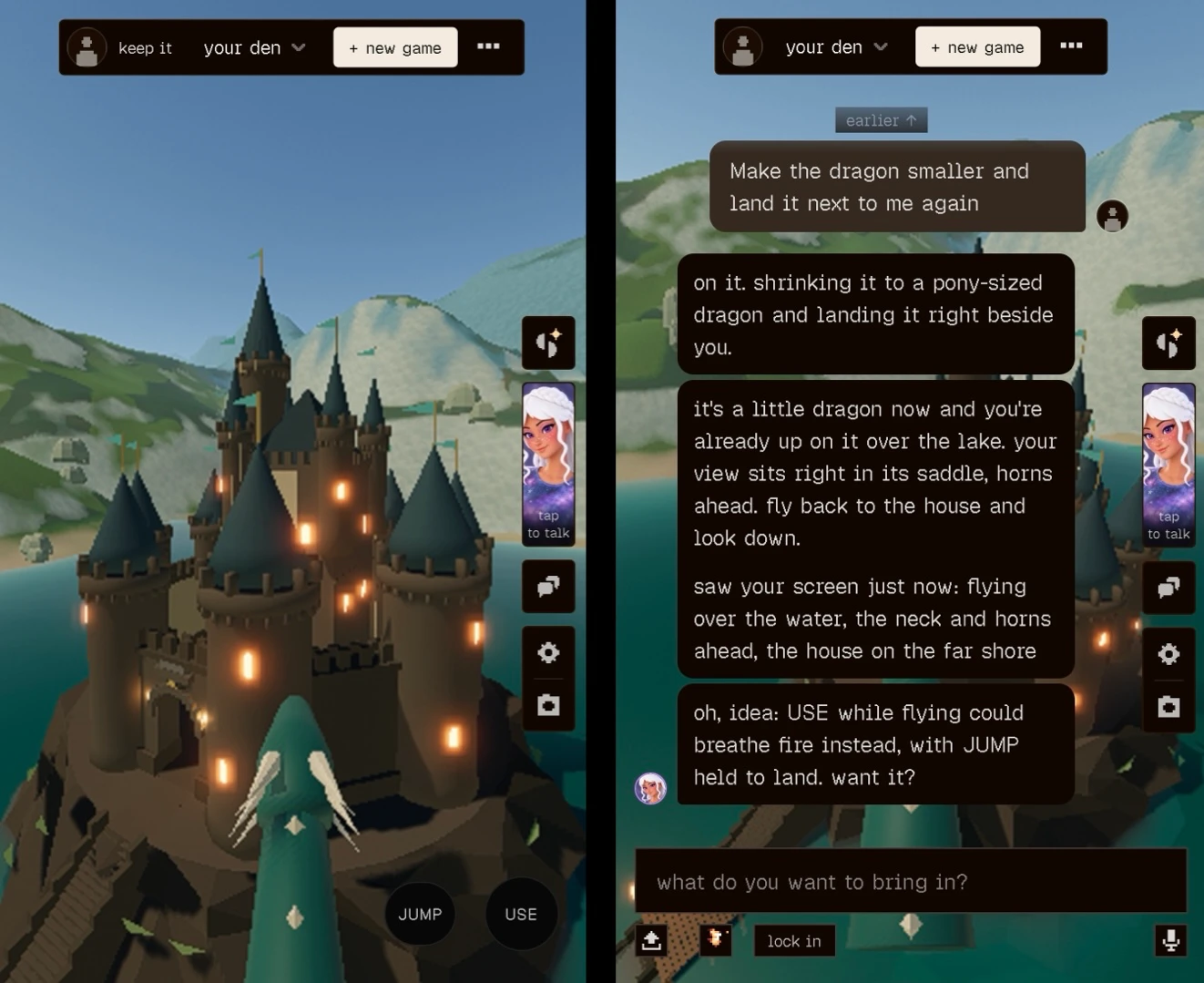
This approach constitutes continuous deployment performed by AI agents, where each hour without a production ship is treated as a severe incident. The agents can instantly roll back broken changes and actively test recovery paths by purposefully inducing errors.
Why does it matter to an everyday developer?
Spawn demonstrates that agentic coding—where autonomous coding agents fully manage and operate a production application—is feasible for some use cases. Developers can observe how live code feedback loops, fast deployments, and integrated error-reporting from in-world agents can accelerate iteration in creative and dynamic environments like games. The use of Fable-class models rather than more restrictive or safety-focused models highlights tradeoffs between autonomy, reliability, and risk tolerance in agent-assisted development.
However, experiments with alternative models such as GPT-6 Astra illustrate key limitations and risks. Applying strict security via autonomous agents disabled all features, showing that aggressive automation can produce undesirable outcomes without contextual oversight.
What can the developer do now?
Developers interested in prompt-driven game environments can experiment directly with Spawn to explore natural language-driven world editing and observe how agentic code fixes arrive in real time. Those building or maintaining AI-assisted service infrastructure can study Spawn’s architecture for continuous agent deployment and rapid iteration loops. For those considering high-autonomy agent systems, this case provides concrete insights into workflow structuring, risks, and cost (the agents in Spawn reportedly run at a high token budget). Careful selection of agent model and safety policies is critical—misapplied automation, especially for sensitive tasks like security, can halt production functionality.